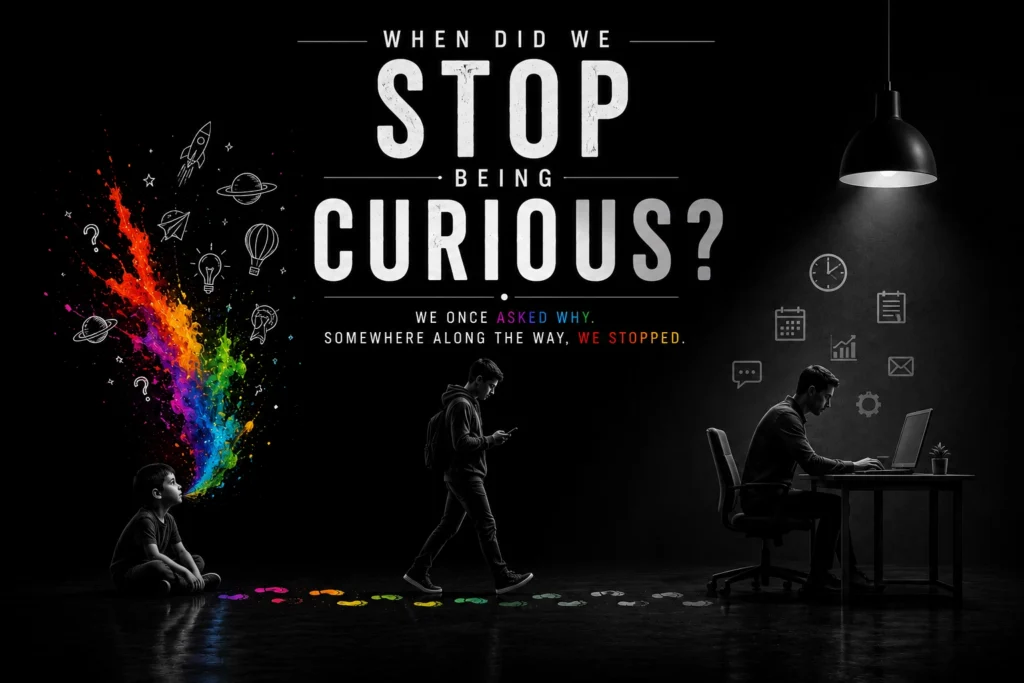
Born to Ask Questions
A child’s natural curiosity can transform an ordinary day into a nonstop series of questions. Why is the sky blue? How do birds manage to fly? Where do the stars go during daylight hours? Children instinctively approach the world with a sense of wonder and amazement. They aren’t afraid to ask questions, since they view anything unfamiliar as a chance to learn something new.
Curiosity ranks among humanity’s oldest and most powerful instincts. It compels children to explore, experiment, and make sense of the world around them. Even more importantly, it teaches them that knowledge isn’t something merely handed to them—it’s something to actively seek out. Yet as people age, many gradually stop asking questions. The sense of wonder that once made the world feel enchanting starts to diminish, and curiosity often turns into a forgotten habit rather than remaining a natural part of everyday life.
The Slow Decline of Wonder
Curiosity rarely fades all at once. Instead, it diminishes slowly, worn down by countless small, everyday experiences. As adults take on responsibilities, careers, and routines, they naturally have less time to explore new ideas and more time devoted to handling daily obligations.
Additionally, society tends to value certainty over curiosity. People are often admired for having answers rather than for asking thoughtful questions. This leads many to conclude that curiosity is something reserved for childhood rather than a skill worth carrying through life. As a result, they stop questioning the world around them and simply begin accepting it at face value.
When Education Prioritizes Answers Over Questions
While education has the power to cultivate curiosity, many educational systems end up stifling it instead, often without meaning to. Schools tend to focus heavily on memorization, testing, and standardized results, teaching students to hunt for the single correct answer rather than explore a range of possibilities.
What’s more, many classrooms reward speed and certainty over experimentation and genuine inquiry. A student who asks numerous questions might even be seen as disruptive or off-task. Over time, young learners come to understand that success is often about producing quick answers rather than engaging in deep thinking. As this pattern continues, curiosity takes a back seat to performance, and learning shifts from a process of discovering meaning to one of simply accumulating information.
Society’s Expectations and the Fear of Looking Ignorant
As individuals grow into adulthood, social expectations start to influence how they act. Adults are frequently expected to project knowledge, competence, and confidence. As a result, many avoid asking questions altogether, worried that doing so might make them seem uninformed or inexperienced.
This fear builds an invisible wall against learning. People often shy away from exploring unfamiliar topics because expressing curiosity can feel like admitting a lack of knowledge. Yet real learning demands humility. Every major discovery starts with someone willing to say, “I don’t know this yet—can I find out more?” Unfortunately, modern society tends to reward confident certainty while overlooking the courage it takes to stay curious.
The Comfort of Routine
Routine offers a sense of stability and efficiency, helping people manage their responsibilities while cutting down on unnecessary stress. However, routines can also become a kind of intellectual trap. When each day mirrors the last, chances for exploration steadily shrink.
Furthermore, familiarity can create the false impression that nothing new remains to be discovered. Adults tend to frequent the same places, carry out the same tasks, and have the same conversations repeatedly. As a result, they stop noticing the many small mysteries woven into everyday life. Curiosity thrives on novelty, and too much routine can quietly replace a sense of wonder with mere predictability.
Digital Distractions and the Death of Deep Curiosity
Technology has given humanity unmatched access to information, with answers to nearly any question available within seconds. Ironically, this overwhelming abundance of information hasn’t necessarily made people more curious.
Instead, digital platforms often promote passive consumption rather than active exploration. Social media feeds continuously deliver entertainment, opinions, and pre-packaged explanations. As a result, people find themselves spending less time wondering and more time simply scrolling. The internet has become a space where answers arrive almost before questions have a chance to form.
Additionally, having instant access to information can create a false sense of being knowledgeable. Skimming a headline or watching a brief video might feel like learning, but genuine curiosity calls for deeper engagement. It requires patience, real investigation, and a willingness to sit with uncertainty for a while. Unfortunately, today’s digital culture often works against these very qualities.
Why Curiosity Matters More Than Ever
Curiosity is far from a minor trait — it forms the very foundation of creativity, innovation, and progress. Every scientific breakthrough, technological leap, and artistic achievement started with someone daring to ask a question that others had overlooked.
Time and again, history has shown the transformative power of curiosity. Explorers set sail across oceans, driven by wonder about what lay beyond the horizon. Scientists reshaped the field of medicine by challenging long-held assumptions. Inventors revolutionized entire industries by envisioning possibilities that didn’t yet exist. Curiosity, then, is more than just an intellectual habit — it stands as one of the most powerful forces driving human progress.
The Link Between Curiosity and Personal Growth
Curiosity’s impact extends beyond advancing society as a whole — it also transforms individuals on a personal level. Curious people consistently pursue new experiences, viewpoints, and knowledge. This makes them more adaptable to change and helps them develop a deeper understanding of both themselves and the world they live in.
Curiosity also fosters empathy. By asking questions about different cultures, beliefs, and life experiences, people become better able to appreciate viewpoints beyond their own. On the other hand, a lack of curiosity tends to result in narrow-mindedness and resistance to change. Genuine personal growth begins when people choose to explore rather than assume, and to question rather than settle for certainty.
Have We Become Too Comfortable?
Modern life tends to prioritize comfort and convenience. Technology streamlines everyday tasks, routines bring predictability, and algorithms tailor experiences to individual preferences. While these advances come with real benefits, they can also limit opportunities for genuine discovery.
When personal preferences are constantly anticipated and needs are met instantly, the drive to explore can start to fade. People grow increasingly at ease with what’s already familiar to them. As a result, they may lose the impulse to seek out new experiences or question existing beliefs. The real danger here isn’t ignorance itself, but the slow erosion of interest in learning anything new.
Rediscovering the Child Within
Children remind adults of an important truth: curiosity is not something that disappears naturally. Instead, itCuriosity is something people frequently overlook, yet the capacity to ask questions never truly disappears — it simply lies dormant, waiting to be reawakened.
Reviving one’s curiosity doesn’t call for grand adventures. It can start with small, simple steps: picking up a book outside your usual genre, learning a new skill, exploring an unfamiliar place, or asking why something functions the way it does. Perhaps most important of all is becoming comfortable with not having instant answers.
Curiosity flourishes when people give themselves permission to wonder once more. It deepens as individuals trade assumptions for questions and certainty for exploration. Every question holds the potential to unlock a new door, and every act of learning pushes the boundaries of human understanding a little further.
A Future That Depends on Questions
The problems confronting today’s world are growing more intricate by the day. Issues like climate change, rapid technological shifts, and evolving social dynamics call for inventive solutions. Such solutions won’t come from simply accepting things as they are — they’ll emerge from curious minds bold enough to ask hard questions and pursue new possibilities.
For this reason, society cannot afford to lose its capacity for wonder. Innovation relies on curiosity. Progress relies on curiosity. Even personal fulfillment relies on curiosity. A world that stops questioning risks falling into stagnation, becoming overly predictable, and resistant to any kind of change.
Final Thoughts: When Did We Stop Being Curious?
Perhaps curiosity never truly left us. Perhaps we simply grew distracted, overwhelmed, and too comfortable. Over time, responsibilities, routines, and social pressures nudged us toward seeking answers rather than asking questions.
Yet the world remains just as fascinating as it was during childhood. The stars continue to shine overhead. The oceans still conceal countless mysteries. Human beings still have so much left to discover — about themselves and about the universe they inhabit.
So the real question isn’t when we lost our curiosity. The question that truly matters is whether we’re willing to welcome it back. Because the instant we begin asking questions again, we start rediscovering the wonder that has been quietly waiting for us all along.