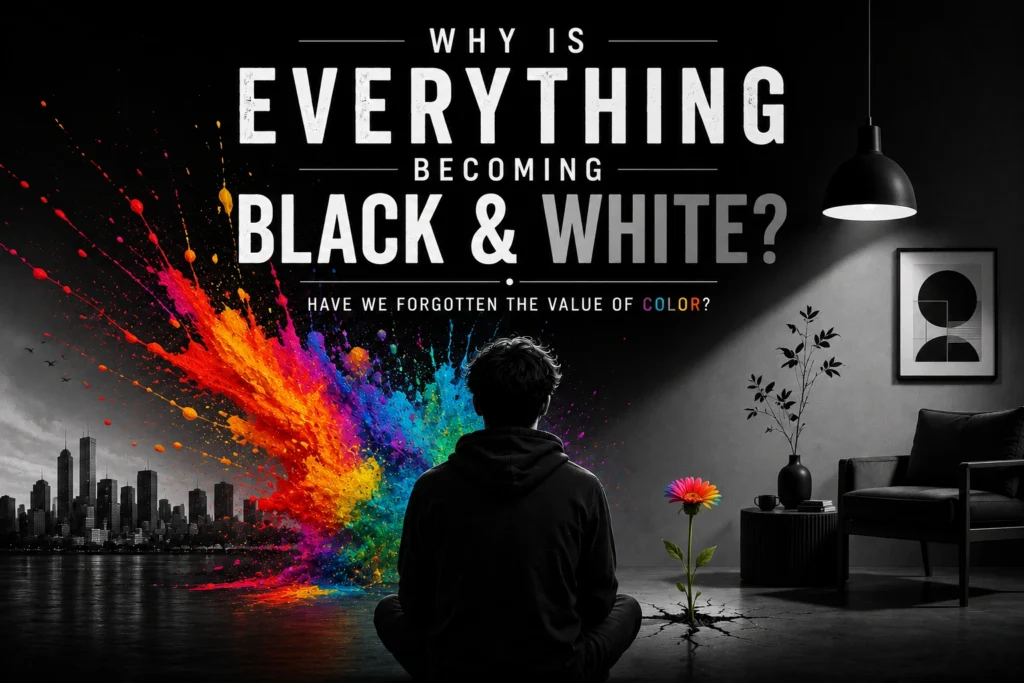
A World Once Painted in Color
Take a look through old photographs, vintage advertisements, or traditional markets, and one thing immediately becomes clear: color used to be everywhere. People wore vibrant clothing, filled their homes with bold patterns, and created products that celebrated individuality and emotional expression. Color wasn’t just decoration — it reflected culture, identity, and a sense of joy.
Today’s world, though, looks quite different. Contemporary apartments lean toward white walls and beige furnishings. Tech companies release their products predominantly in black, silver, and gray. Fashion trends center around monochrome looks and neutral tones. As a result, many have begun to question whether society has gradually lost its love for color.
The Rise of Minimalism and Monochrome
Over the past ten years, minimalism has evolved from being just a design approach into a full-fledged cultural movement. It promotes owning fewer things, eliminating distractions, and finding value in simplicity. Consequently, black, white, and neutral tones have come to define the visual style of contemporary living.
Minimalism also tends to link clean, uncluttered spaces with productivity and sophistication. Designers gravitate toward monochrome palettes because they evoke a sense of order and calm, while brands adopt this aesthetic since simple colors convey elegance and timelessness. In this way, monochrome has come to represent modernity itself, rather than being just another stylistic preference.
Why Do We Associate Black and White with Sophistication?
Psychology plays a major role in why people gravitate toward monochrome aesthetics. Black is often linked to power, luxury, and authority, while white conveys cleanliness, simplicity, and perfection. Combined, these two colors project an image of professionalism and refinement.
Society continually reinforces these associations as well. Luxury vehicles are commonly seen in black or white. Corporate offices often adopt neutral color schemes to project seriousness and efficiency. High-end fashion labels lean heavily on monochrome branding. Over time, this leads people to unconsciously associate colorful designs with being less professional, or even less mature.
Brands Have Quietly Abandoned Color
A clear shift has taken place in branding over the past several years. Numerous companies have streamlined their logos, stripping away vibrant elements from their visual identities. Businesses now often favor black-and-white logos, viewing them as more modern, adaptable, and premium.
However, this shift has also led to a certain sameness across brands. When many companies follow the same minimalist design principles, they start to blend together and look strikingly alike. While this approach brings consistency and elegance, it frequently comes at the cost of individuality and emotional resonance. In other words, companies may gain a polished sophistication, but lose part of what made them distinct.
The Neutral Home: Comfort or Sterility?
Interior design has undergone a similar transformation. Social media is filled with images of homes featuring white walls, beige sofas, gray kitchens, and wooden accents. These spaces come across as clean, well-organized, and visually appealing.
Still, an important question lingers: do these spaces genuinely feel alive? Color has a unique ability to stir emotion, trigger memories, and add warmth to a space. A vividly colored living room can feel inviting and full of energy, whereas a completely neutral space can sometimes come across as cold or impersonal. In striving for visual perfection, we may have inadvertently created homes that look stunning but lack real emotional depth.
Fashion’s Love Affair with Monochrome
Fashion trends further reflect society’s increasing preference for neutral shades. Black clothing continues to dominate wardrobes thanks to its versatility and timeless appeal. White and beige pieces suggest elegance and simplicity. As a result, many view monochrome fashion as a safer, more refined choice.
Yet clothing has traditionally served as a powerful means of self-expression. Bold, vibrant colors often signal confidence, creativity, and cultural identity. By increasingly gravitating toward neutral tones, people may be unintentionally limiting their chances to express who they really are. In this way, fashion shifts from being a form of storytelling to becoming more about fitting in.
Technology and the Aesthetic of Simplicity
Tech companies have played a major role in shaping modern design trends. Smartphones, laptops, and smart devices are frequently released in black, silver, gray, and white. Manufacturers deliberately choose these colors because they convey a premium feel and appeal to a wide range of users.
Digital interfaces have similarly embraced minimalism. Websites and apps often feature streamlined layouts with restricted color schemes, an approach that boosts usability and cuts down on distractions. That said, too much simplicity can leave digital experiences feeling emotionally flat. In gaining efficiency, technology has, in some ways, lost a bit of its playfulness and expressive character.
Social Media and the Pursuit of the Perfect Feed
Social media has played a major role in accelerating the rise of monochrome aesthetics. Influencers carefully craft their feeds using neutral tones and cohesive themes. As these visuals gain traction, they set new benchmarks for what’s considered beautiful and sophisticated.
As a result, users often feel pressure to match these same aesthetic standards. Bright, colorful styles can start to seem less fashionable by comparison. Over time, algorithms favor certain visual trends, prompting millions to adopt the same muted color schemes. In this sense, social media doesn’t just mirror cultural trends — it actively drives and reshapes them.
What We Lose When Color Disappears
Color has a profound impact on human emotions. Vibrant hues can spark creativity, boost energy levels, and deepen emotional bonds. Across cultures, colors also carry rich symbolic meaning, playing a central role in celebrations, traditions, and significant life milestones.
As society leans further into monochrome aesthetics, it risks losing touch with some of these emotional experiences. A world dominated by black, white, and gray may come across as efficient and refined, but it can also feel less joyful and less human. Creativity tends to flourish in environments that embrace diversity, and color stands as one of the most powerful expressions of that diversity.
Have We Mistaken Simplicity for Beauty?
There’s no denying that simplicity has real value — minimalist design can cut down on visual clutter and foster a sense of calm. Even so, embracing simplicity shouldn’t mean rejecting color altogether. True beauty lies in balance, not extremes.
In many respects, society has come to equate monochrome design with intelligence, professionalism, and status. As a result, people sometimes shy away from colorful choices, worried they might seem childish or out of touch. Yet color and sophistication aren’t mutually exclusive. A vibrant, colorful world can still be elegant, modern, and refined.
Rediscovering the Value of Color
Perhaps society hasn’t truly fallen out of love with color at all — perhaps we’ve simply forgotten how much value it holds. Color remains closely tied to memory, emotion, and identity. Festivals, sunsets, blooming flowers, and works of art continue to move us deeply precisely because they’re rich with meaningful color.
The challenge, then, isn’t to abandon minimalism, but to thoughtfully bring color back into our lives. We can value simplicity while still making room for warmth, creativity, and individuality. Adding a touch of color to our homes, clothing, brands, and digital spaces might just remind us that life was never meant to be lived entirely in shades of black and white.
Final Thoughts: Is the World Truly Becoming Black and White?
The rising fascination with monochrome design mirrors broader shifts in culture. As society places increasing value on order, efficiency, and sophistication, black-and-white aesthetics have become the perfect visual symbol of these ideals. Yet every trend comes with trade-offs.
As we keep simplifying the world around us, it’s worth pausing to ask a meaningful question: have we chosen elegance at the cost of emotional richness? Perhaps color hasn’t truly been abandoned — perhaps we’ve simply become so preoccupied with looking modern that we’ve lost sight of the joy, warmth, and humanity that color brings into our lives.
Ultimately, the answer may not be about picking sides between monochrome and color. It may instead be about recognizing that both have their place. After all, life finds its meaning not in being purely black and white, but in embracing every shade in between.